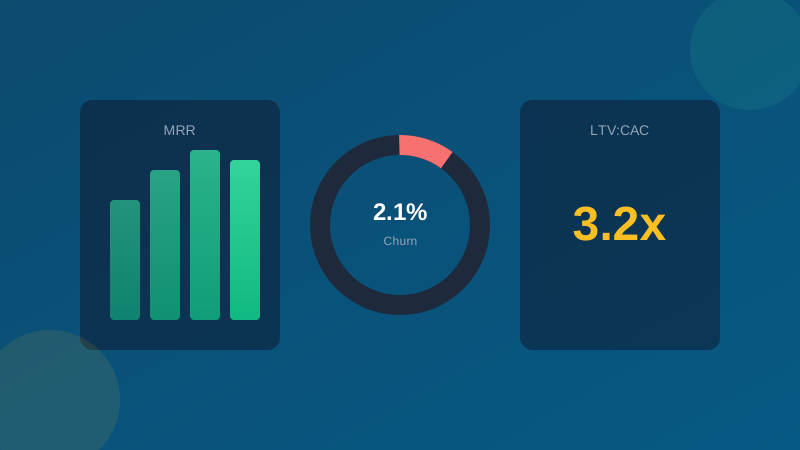
Every SaaS company tracks MRR and churn rate, but the companies that truly scale. The ones that reach $10M, $50M, $100M ARR - track more sophisticated metrics that reveal deeper insights into business health and growth potential. This guide covers the metrics that separate good SaaS companies from great ones, with real benchmarks, calculation examples, and the frameworks you need to make data-driven decisions at every growth stage.
The SaaS Metrics Hierarchy
Think of SaaS metrics in three tiers. The foundation keeps the lights on. The middle layer is where insight happens, and the top tier is where strategic advantage lives. Most companies get stuck at the foundation tier, obsessing over topline MRR while missing the signals that predict whether that MRR will grow or collapse six months from now.
Foundation Metrics (Everyone Tracks These)
- Monthly Recurring Revenue (MRR): Your subscription revenue normalized to a monthly figure. This is the heartbeat of any SaaS business. Annual contracts should be divided by 12. Exclude one-time setup fees, professional services, and usage overages unless they represent contracted minimums.
- Customer Churn Rate: The percentage of customers who cancel in a given period. Monthly logo churn above 5% is a red flag demanding immediate attention. For context, that compounds to over 46% annual churn, meaning nearly half your customer base leaves every year.
- Customer Acquisition Cost (CAC): Total sales and marketing spend divided by new customers acquired. Include everything: salaries, commissions, tools, ad spend, content creation costs, events, and allocated overhead. Most companies undercount CAC by 30-40% by omitting staff costs and tools.
- Lifetime Value (LTV): Total revenue expected from a customer over the entire relationship. The classic formula is ARPU multiplied by Gross Margin divided by Monthly Churn Rate. A more nuanced approach uses cohort-based LTV that accounts for how customer value changes over time rather than assuming constant behavior.
Advanced Metrics (Where Insight Happens)
- Net Revenue Retention (NRR): Revenue retained plus expansion from existing customers. The single most predictive metric for long-term growth. An NRR above 100% means your existing base is growing without any new customers.
- Gross Revenue Retention (GRR): Revenue retained before expansion, showing your baseline product stickiness. GRR can never exceed 100%, and below 85% indicates a fundamental product-market fit concern.
- Quick Ratio: Growth efficiency measured as (New MRR + Expansion MRR) divided by (Churned MRR + Contraction MRR). Tells you whether your growth is sustainable or whether you're running on a treadmill.
- Magic Number: Net new ARR in a quarter divided by prior quarter's sales and marketing spend. Indicates whether additional sales investment will yield proportional returns.
- Burn Multiple: Net burn divided by net new ARR. Measures how efficiently you convert cash into recurring revenue growth. Below 1.5x is exceptional; above 3x is concerning.
Leading Indicators (Predict Future Performance)
- Product Qualified Leads (PQLs): Users showing buying signals through product usage, such as hitting usage limits, inviting team members, or integrating data sources. PQLs convert at 3-5x higher rates than marketing qualified leads for product-led growth companies.
- Feature Adoption Rates: How quickly users adopt key features, particularly "sticky features" that correlate with long-term retention. Identifying these features and building onboarding around them is one of the highest-leverage activities in SaaS.
- Time to Value (TTV): How quickly customers experience the core value proposition. Companies that significantly reduce TTV consistently see higher activation rates, with some reporting improvements of 2x or more, because every additional day of friction is an opportunity for the customer to lose interest.
- Onboarding Completion Rates: Percentage completing initial setup milestones. Incomplete onboarding is the single largest predictor of early churn. Customers who don't complete onboarding within the first 72 hours churn at 3-4x the rate of those who do.
Net Revenue Retention (NRR), in Detail
NRR is arguably the most important SaaS metric because it tells you whether your product creates enough value for customers to not just stay, but spend more over time. An NRR above 100% means your existing customer base is growing even without acquiring a single new customer. It's the closest thing SaaS has to a crystal ball.
NRR Formula
NRR = (Starting MRR + Expansion MRR - Churned MRR - Contraction MRR) / Starting MRR × 100
Worked Example
Suppose you start the month with $100,000 in MRR from 200 customers:
- 10 customers upgrade their plans, adding $8,000 in expansion MRR
- 5 customers cancel, losing $3,500 in churned MRR
- 8 customers downgrade, losing $2,000 in contraction MRR
NRR = ($100,000 + $8,000 - $3,500 - $2,000) / $100,000 × 100 = 102.5%
This means your existing customer base grew by 2.5% in a single month, or roughly 34% annualized. Before you added any new customers. That compounding effect is why investors obsess over NRR. At 120% NRR, your existing revenue doubles every 3.8 years with zero new customer acquisition.
NRR Benchmarks by Company Stage and Segment
NRR benchmarks vary significantly by customer segment:
- Enterprise SaaS (ACV $100K+): Top quartile is 130%+. Snowflake reported 158% net revenue retention in its S-1 filing. Twilio reported 155%+ NRR during its peak growth period. Datadog consistently reports 130%+. These companies succeed because enterprise customers expand usage across teams and use cases over time.
- Mid-market SaaS (ACV $10K-$100K): Top quartile is 115-125%. Strong expansion motions through seat-based pricing and feature upgrades drive this range.
- SMB SaaS (ACV under $10K): Top quartile is 100-110%. SMB NRR above 110% is rare because small businesses have less room to expand and higher natural churn rates due to business closures.
- Consumer/Prosumer SaaS: NRR above 100% is exceptional. Most consumer products should focus on logo retention rather than revenue expansion.
How to Improve NRR
Improving NRR requires coordinated effort across product, pricing, and customer success:
- Usage-based pricing: Revenue grows naturally as customers use more. Companies with usage-based models average 120%+ NRR versus 110% for seat-based models. Snowflake, Datadog, and Twilio all use consumption-based pricing as their primary expansion engine.
- Expansion paths: Build clear upgrade tiers with meaningful differentiation, add-on modules that solve adjacent problems, and premium features that unlock as customer sophistication grows. The key is making expansion feel like a natural progression rather than a sales pitch.
- Proactive customer success: Reach out before customers disengage. Monitor health scores combining login frequency, feature adoption, support sentiment, and usage trends. Intervene at the first sign of declining engagement. By the time a customer requests cancellation, the relationship is usually beyond saving.
- Land and expand strategy: Start with a single team or department and prove value, then expand across the organization. Slack grew from single teams to entire enterprises. Figma spread from individual designers to full design organizations. The product must deliver enough value to one team that other teams hear about it through internal word-of-mouth.
Cohort Analysis: The Most Underused Tool in SaaS
Cohort analysis groups customers by acquisition date and tracks their behavior over time. This reveals patterns that are completely invisible in aggregate metrics, and it's the only reliable way to know whether your product is actually getting better at retaining customers or whether improving topline numbers are simply masking persistent retention problems.
What Cohort Analysis Reveals
- Retention curves: Do recent cohorts retain better than older ones? If your January 2026 cohort retains at 88% after three months while your January 2025 cohort retained at 82% at the same point, your product improvements are working. If not, you may have a leaky bucket that no amount of acquisition spending can fill.
- Revenue expansion: Are customers spending more over time, or does revenue per account flatten after month 3? This directly informs whether your pricing and packaging strategy is working or whether you have hit a natural ceiling for expansion within your current customer base.
- Payback periods by cohort: How many months does it take for each cohort to generate enough cumulative gross margin to cover its acquisition cost? If payback is getting longer over time, your growth may be unsustainable even if CAC looks stable, because you're acquiring less valuable customers as you move beyond early adopters.
- Seasonal patterns: Do customers acquired in January behave differently from July cohorts? B2B SaaS companies often see stronger retention from Q1 cohorts (new budget cycles, fresh initiatives) compared to Q4 cohorts (rushed end-of-year purchases with less commitment). These patterns affect budgeting and growth planning.
- Channel quality: Segment cohorts by acquisition channel to see which channels produce the highest-quality, longest-retaining customers. You may discover that your cheapest acquisition channel (viral/referral) also produces the best retention, while your most expensive channel (outbound sales) produces customers with a shorter lifespan.
Building a Retention Cohort Table
A retention cohort table shows the percentage of each monthly cohort that remains active over time. Here's how to read one:
- Each row represents a monthly cohort (all customers acquired in a specific month, such as January 2026)
- Each column represents months since acquisition (Month 0, Month 1, Month 2, and so on)
- Each cell shows the percentage of that cohort still active at that point
A healthy SaaS product shows retention curves that flatten between month 3 and month 6. The initial drop is natural. Some customers aren't a good fit, some were just experimenting, and some hit implementation friction, but if curves keep declining after month 12 without flattening, you have a product-market fit problem that acquisition spending can't solve. You're adding water to a bathtub with the drain open.
Revenue Cohort Analysis
Revenue cohorts take it further by tracking dollars instead of customer logos. A cohort might lose 10% of its customers but grow 15% in revenue if remaining customers expand their usage and plans. This is the NRR story told at the cohort level, and it reveals whether expansion is concentrated in a few large accounts (risky) or broadly distributed across many customers (healthy).
The most valuable insight from revenue cohorts is the "smile curve" - when a cohort's revenue initially dips (early churn) but then grows beyond its starting point as surviving customers expand. A smile curve that appears earlier and rises more steeply in recent cohorts is one of the strongest signals that product-market fit is deepening.
SaaS Metrics by Growth Stage
The metrics that matter change as your company grows. Tracking the wrong metrics at the wrong stage leads to bad decisions. Here's what to focus on at each stage, and what mistakes to avoid.
Pre-Product/Market Fit (Pre-Seed to Seed, under $1M ARR)
Focus on: engagement and retention, not revenue metrics.
- Primary metric: Weekly active usage retention. Are people coming back to the product without being prompted? If fewer than 40% of users return in week 2, you haven't found product-market fit yet.
- Daily/Weekly Active Users: More important than MRR at this stage. A product with 1,000 highly engaged free users and $0 MRR is closer to product-market fit than a product with $50K MRR from 20 customers who were sold hard and rarely log in.
- Qualitative NPS and churn interviews: Talk to every churned user. At this stage, you need qualitative insights about why people leave, not statistical dashboards. Every churned user interview is worth more than a week of dashboard staring.
- Time to Value: How fast do users experience the core value proposition? If TTV is more than 24 hours for a self-serve product, onboarding friction is killing your growth before it starts.
Common mistake: Obsessing over MRR growth before you have repeatable retention. You're filling a leaky bucket. Fix the holes first. No amount of top-of-funnel marketing fixes a product that people don't come back to.
Finding Product/Market Fit (Seed to Series A, $1M-$5M ARR)
Focus on: retention stabilization and early unit economics.
- Logo retention rate: Target 90%+ monthly retention, meaning less than 10% monthly logo churn. If you can hold this for 3+ consecutive months across 100+ customers, you likely have product-market fit for your initial segment.
- Net Revenue Retention: Aim for 100%+ to prove expansion potential. Below 100% means every dollar of growth requires a new dollar of acquisition. An expensive way to build a business.
- CAC Payback Period: Under 18 months is the standard benchmark at this stage. Longer payback periods mean you need more capital to grow, which means more dilution.
- Gross Margin: Should be 70%+ for pure software SaaS. If below 60%, you likely have a services component or infrastructure costs that won't scale. Margins below 50% indicate you're running a services business disguised as a SaaS business.
Common mistake: Premature scaling of the sales team before retention is stable. Hiring 10 salespeople when monthly churn is 8% means you're paying them to fill a bucket that loses nearly two-thirds of its contents every year.
Scaling (Series A to B, $5M-$25M ARR)
Focus on: efficiency and scalability of growth.
- LTV:CAC Ratio: Target 3:1 or higher. Below 3:1 means acquisition is too expensive relative to the value captured. Above 5:1 may mean you're under-investing in growth and leaving market share on the table.
- Quick Ratio: Target 4:1 or higher. For every dollar of MRR lost, you add four. This proves growth is sustainable and not just aggressive spending. A Quick Ratio below 2:1 means you're working very hard just to stay in place.
- Magic Number: Above 0.75 signals efficient sales. Every $1 of sales and marketing spend generates $0.75+ of new ARR. Between 0.5-0.75, invest cautiously and focus on efficiency improvements. Below 0.5, fix your funnel before spending more money on sales headcount.
- Burn Multiple: Net burn divided by net new ARR. Below 1.5x is excellent. Between 1.5-2.5x is acceptable for high-growth companies. Above 3x is concerning. Above 5x requires immediate operational changes.
Common mistake: Chasing growth rate at all costs without monitoring efficiency metrics. A company growing 100% year-over-year with a burn multiple of 6x is destroying value, not creating it. Growth that isn't efficient isn't fundable in most market environments.
Late Stage (Series C+, $25M+ ARR)
Focus on: capital efficiency, market position, and path to profitability.
- Rule of 40: Revenue growth rate plus free cash flow margin should exceed 40%. At $50M ARR, growing 30% with 15% FCF margins (equaling 45) is strong. Growing 60% with negative 40% margins (equaling 20) isn't sustainable and won't be rewarded by investors or markets.
- Net Revenue Retention: 120%+ is table stakes for premium valuations at this stage. Public SaaS companies with NRR above 120% trade at roughly 2x the revenue multiple of peers with NRR below 110%.
- Gross Dollar Retention: Above 90% shows the core product is inherently sticky, independent of any upselling motion. GDR below 85% at scale is a structural problem that expansion revenue is masking.
- Revenue per Employee: Benchmark is $200K-$300K ARR per employee for efficient SaaS companies at scale. Top performers like Zoom and Atlassian exceed $500K. Below $150K suggests over-hiring or operational inefficiency that will compress margins.
Common mistake: Failing to diversify revenue concentration. If your top 10 customers represent more than 30% of ARR, you have concentration risk that reduces your valuation in acquisition or IPO scenarios. Losing a single large customer shouldn't materially impact your growth rate.
The SaaS Quick Ratio: Measuring Growth Sustainability
The Quick Ratio is one of the most elegant metrics in SaaS because it captures growth quality in a single number. It answers the fundamental question: is your growth engine building momentum, or are you running on a treadmill?
Formula
SaaS Quick Ratio = (New MRR + Expansion MRR) / (Churned MRR + Contraction MRR)
Interpretation and Benchmarks
- Above 4:1: Very healthy. For every dollar lost, you add four or more. Growth is sustainable, efficient, and compounding. Most successful SaaS IPOs maintain Quick Ratios above 4:1 in the years leading up to their public offering.
- 2:1 to 4:1: Acceptable but requires monitoring. Growth is happening but the bucket has noticeable holes. Investigate whether churn is concentrated in a specific segment, channel, or cohort.
- 1:1 to 2:1: Danger zone. You're working very hard just to stay in place. Most of your growth effort is being consumed by replacing lost revenue. Prioritize retention immediately before investing further in acquisition.
- Below 1:1: Shrinking. You're losing more revenue than you're adding. Without immediate intervention, the business is in decline regardless of what topline MRR looks like this month.
Quick Ratio in Context
Consider two companies both adding $50K in new and expansion MRR per month. Company A loses $30K to churn and contraction (Quick Ratio of 1.67). Company B loses only $10K (Quick Ratio of 5.0). Both show $50K in gross additions on their investor reports, but Company B nets $40K while Company A nets only $20K. After 12 months, Company B has added $480K in net MRR while Company A has added $240K - despite identical gross growth efforts. This is why the Quick Ratio matters more than raw growth numbers.
CAC Payback and LTV:CAC - The Unit Economics That Fund Growth
CAC Payback Period
Formula: CAC / (Monthly ARPA × Gross Margin)
Where ARPA is Average Revenue Per Account per month, and Gross Margin accounts for the direct costs of delivering the service.
Worked Example
Consider a SaaS company with the following metrics:
- Fully loaded CAC (including salaries, tools, and overhead): $12,000
- Monthly ARPA: $500
- Gross Margin: 80%
Payback = $12,000 / ($500 × 0.80) = 30 months
At 30 months, this is too long. The benchmark is under 18 months for most SaaS businesses, and under 12 months is considered efficient. A 30-month payback means every new customer ties up capital for 2.5 years before generating any return. Fine if you have unlimited funding, dangerous if you don't.
Strategies to Reduce CAC Payback
- Improve conversion rates: Better onboarding, clearer value propositions, and product-led growth motions reduce the number of leads you need per closed deal. Doubling your trial-to-paid conversion rate halves your effective CAC.
- Increase ARPA: Raise prices (most SaaS companies are underpriced), introduce annual billing with a modest discount (improves cash flow dramatically even if ARR stays flat), or add premium tiers that capture more value from power users.
- Reduce CAC: Content marketing and inbound strategies typically have 60-70% lower CAC than outbound sales for SMB SaaS. Invest in channels that compound over time (SEO, community, product-led growth) rather than channels with linear cost structures (paid ads, outbound SDRs).
- Annual billing: Offering 10-20% discounts for annual prepayment can make CAC payback nearly instant from a cash flow perspective, even if the accounting payback period stays the same. This is one of the most underused levers in SaaS.
LTV:CAC Ratio
Formula: LTV / CAC, where LTV = Monthly ARPA × Gross Margin / Monthly Churn Rate
Benchmarks and interpretation:
- Below 1:1: You're losing money on every customer acquired. Stop acquisition spending and fix the product or pricing.
- 1:1 to 3:1: Marginally viable. Growth isn't self-funding and requires continuous capital injection.
- 3:1 to 5:1: The sweet spot. Efficient growth with room for reinvestment in product, team, and go-to-market.
- Above 5:1: You may be under-investing in growth. Consider spending more aggressively on acquisition. You have a proven model that converts efficiently, and you're leaving market share on the table.
Common Mistakes in SaaS Metric Tracking
Even experienced teams make these errors. Each one can lead to strategic missteps that compound over quarters.
1. Mixing Up MRR Calculations
MRR should include only recurring subscription revenue. Don't include one-time setup fees, professional services revenue, or usage overages above contracted minimums. Mixing these inflates your MRR and gives a false picture of recurring business health. Investors will catch this during due diligence, and the correction will be painful.
2. Ignoring Contraction MRR
Many teams track new MRR and churned MRR but forget contraction MRR - revenue lost from customers who downgrade their plans. A customer moving from $500/month to $200/month is technically retained, but you just lost $300/month of MRR. Ignoring contraction makes your retention metrics look artificially strong and hides a pricing or packaging problem.
3. Counting Reactivations as New Revenue
When a churned customer comes back, that's reactivation MRR, not new MRR. Lumping them together inflates your new customer acquisition metrics and masks your true acquisition effectiveness. Track reactivation as its own MRR category to understand how much of your "new" revenue is actually returning customers.
4. Using Blended CAC Across Channels
A blended CAC of $5,000 might hide the fact that organic inbound produces $1,200 CAC while outbound sales produces $18,000 CAC. Channel-specific CAC reveals where to invest and where to cut. Without channel segmentation, you can't make informed decisions about your go-to-market mix.
5. Measuring Churn at the Wrong Cadence
If customers sign annual contracts, monthly churn measurements create statistical noise and false alarms. A customer isn't "at risk" of churning every month. They can only churn at their renewal date. Track churn at the contract renewal cadence. For mixed contract terms, segment your churn metrics by contract length.
6. Not Segmenting Metrics by Customer Type
Aggregate metrics hide critical patterns. Your overall NRR might be 108%, but enterprise NRR is 135% while SMB NRR is 85%. These require completely different strategies. One needs more investment, the other needs a fundamentally different approach. Blended numbers obscure this and lead to one-size-fits-all strategies that serve no one well.
7. Confusing Bookings with Revenue
A signed $120K annual contract is $120K in bookings but only $10K in monthly revenue. Celebrating bookings as if they were revenue leads to premature spending decisions. Track bookings for pipeline and forecasting purposes, but make all financial decisions based on recognized revenue.
Metric Correlation Analysis: Connecting the Dots
Individual metrics are useful for point-in-time assessment. Correlated metrics are powerful for prediction and strategy. Here are the key correlations every SaaS company should monitor.
Feature Adoption to Retention
Track which specific features correlate with 6-month and 12-month retention. For most SaaS products, there are 2-3 "sticky features" whose adoption in the first 14-30 days predicts long-term retention with 80%+ accuracy. These might not be your most impressive features, often they're mundane capabilities like integrations, team invites, or automated workflows that embed the product into daily routines. Find these features through correlation analysis and build your entire onboarding experience around driving adoption of them.
Time to Value to Expansion Revenue
Customers who reach their first meaningful outcome faster tend to expand more aggressively. If TTV decreases from 14 days to 3 days, expansion rates typically increase 20-40%. The mechanism is trust: customers who experience value quickly develop confidence in the product sooner, which makes them more receptive to expansion offers and more likely to champion the product internally.
Support Ticket Volume to Churn Risk
A sudden increase in support tickets from an account often precedes churn by 60-90 days. This is because support tickets are a lagging indicator of frustration. By the time a customer starts filing tickets, they have already been struggling silently for weeks. Track support ticket velocity per account and flag any account whose weekly ticket volume exceeds 2 standard deviations above their historical average.
NPS Score to Revenue Outcomes
Promoters (NPS 9-10) tend to expand at significantly higher rates than passives (NPS 7-8). Detractors (NPS 0-6) churn at markedly higher rates than promoters. Use NPS as a leading indicator for revenue outcomes by building automated workflows: when an account's NPS drops from promoter to passive, trigger a customer success outreach. When NPS drops to detractor, trigger an executive escalation.
Building Your SaaS Metrics Dashboard
Not all metrics belong on the same dashboard. Organize by audience, decision cadence, and actionability.
Board-Level Dashboard (Monthly/Quarterly)
- ARR and ARR growth rate (year-over-year)
- Net Revenue Retention (trailing 12 months)
- Gross Margin trend
- Rule of 40 score
- Cash position and runway in months
- Customer count by segment and logo churn rate
Executive Dashboard (Weekly)
- MRR movement breakdown (new, expansion, contraction, churn, reactivation)
- Pipeline coverage ratio (pipeline value divided by quota)
- Quick Ratio (trailing 3-month average)
- CAC Payback by acquisition channel
- Top 10 accounts flagged as at-risk by health score
Operational Dashboard (Daily)
- Trial-to-paid conversion rate (trailing 7-day and 30-day)
- Feature adoption rates by active cohort
- Support ticket volume, response time, and resolution time
- Onboarding completion rate and stage-by-stage drop-off
- Product health score distribution across all active accounts
Frequently Asked Questions
What is a good churn rate for SaaS?
For B2B SaaS, monthly logo churn below 2% (roughly 22% annual) is considered acceptable for SMB-focused products. Mid-market products should target below 1% monthly. Enterprise SaaS with annual contracts should target gross dollar retention above 90%, which translates to under 10% annual revenue churn. Consumer SaaS typically sees higher churn rates, with 5-7% monthly being common. The key context is your contract structure. Monthly contracts naturally show higher churn rates than annual contracts because customers have more frequent decision points.
How do you calculate MRR correctly?
MRR equals the sum of all recurring subscription revenue, normalized to a monthly amount. Annual contracts should be divided by 12. Multi-year contracts should also be divided to a monthly figure. Exclude one-time fees, usage overages above contracted minimums, and professional services revenue. Track MRR in five components: New MRR (first-time customers), Expansion MRR (upgrades and add-ons), Contraction MRR (downgrades), Churned MRR (cancellations), and Reactivation MRR (returning customers). The sum of these five components equals your net new MRR for any given period.
What is the Rule of 40 and why does it matter?
The Rule of 40 states that a healthy SaaS company's year-over-year revenue growth rate plus its free cash flow margin should equal or exceed 40%. It matters because it measures the balance between growth and profitability. The two primary value creation levers for any SaaS business. A company growing at 50% with negative 5% margins scores 45, passing the rule. A company growing at 10% with 35% margins also scores 45. Both are viable but pursuing different strategies. Public SaaS companies scoring above 40 trade at significantly higher revenue multiples, often 2-3x higher than peers scoring below 40 - because they have demonstrated they can create value sustainably.
How often should SaaS metrics be reviewed?
Match review cadence to the metric's velocity and actionability. Revenue metrics (MRR components, new customers) should be tracked daily and reviewed in weekly leadership meetings. Efficiency metrics (CAC Payback, LTV:CAC, Magic Number, Burn Multiple) should be reviewed monthly using trailing 3-month windows to smooth out single-month volatility. Strategic metrics (Rule of 40, NRR, revenue per employee) should be reviewed quarterly with board-level context. Cohort analysis should be updated monthly but analyzed quarterly to ensure enough data points for meaningful trend identification. Avoid reviewing slow-moving metrics too frequently. It creates noise and false urgency that leads to overcorrection.
What is the difference between gross and net revenue retention?
Gross Revenue Retention (GRR) measures how much revenue you keep from existing customers without counting any expansion. It can never exceed 100% and represents your product's baseline stickiness. Net Revenue Retention (NRR) includes expansion revenue from upgrades, cross-sells, and usage growth, so it can and ideally does exceed 100%. Think of GRR as the floor and NRR as the floor plus the ceiling. A company with 92% GRR and 115% NRR has solid retention with healthy expansion. A company with 80% GRR and 115% NRR has the same net outcome but a much leakier bucket that expansion is compensating for. A riskier position because expansion efforts could slow down while the leak persists.
How do you benchmark CAC by acquisition channel?
Typical B2B SaaS CAC ranges by channel include: organic search and content marketing at $500-$2,000, paid search at $2,000-$5,000, social media advertising at $1,500-$4,000, outbound SDR-led sales at $5,000-$15,000, channel partnerships at $3,000-$8,000, and events and conferences at $8,000-$20,000. These ranges vary enormously by average contract value. Enterprise deals with $100K+ ACV can justify $30K+ CAC while SMB products with $1,200 ACV need CAC below $2,000 to be viable. Always segment CAC by channel and customer segment simultaneously, because the same channel may perform differently across segments.
Should early-stage startups track all these metrics?
No. Pre-product/market fit, track only three things: weekly active user retention (are people coming back?), qualitative churn reasons (why are they leaving?), and Time to Value (how fast do they get it?). Adding metric complexity before you have 50-100 paying customers creates a false sense of analytical rigor while distracting from the only thing that matters at this stage, building something people want to keep using. Once you have consistent monthly retention above 85% and a meaningful customer base, layer in NRR, CAC Payback, and cohort analysis. Save Rule of 40, Magic Number, and Burn Multiple for Series A and beyond when you have enough scale and data to make them statistically meaningful.
Conclusion: Metrics as a Diagnostic System, Not a Scoreboard
The most important thing to understand about SaaS metrics is that they form an interconnected system, not a collection of independent numbers. NRR drives growth compounding. CAC Payback determines how fast you can reinvest. The Quick Ratio reveals whether your growth engine is building momentum or running in place, and cohort analysis tells you whether your product is getting better over time or simply acquiring its way past persistent weaknesses.
Don't treat your metrics dashboard as a scoreboard you check monthly. Treat it as a diagnostic tool that surfaces the next question you should be asking. When NRR dips, investigate which segments are contracting. When CAC rises, determine which channels degraded. When a cohort retains poorly, identify what changed in the product experience or acquisition source. The companies that win in SaaS aren't necessarily the ones with the best metrics at any point in time. They're the ones that ask the best questions of their data and act on the answers fastest.
Ready to track your SaaS metrics with AI-powered intelligence? clariBI connects to your revenue systems and helps you track and analyze SaaS metrics like MRR, churn, and retention with connected data sources and AI-powered dashboards with automated dashboards and natural language queries. Ask your data a question and get instant, actionable answers.