E-commerce analytics is not one-size-fits-all. A store doing $50,000 per month needs different metrics, different tools, and a different analytical mindset than one doing $5 million per month. The mistake most e-commerce operators make is either tracking too little (flying blind) or tracking too much (drowning in data that does not drive action). This guide maps the right analytics focus to each growth stage, so you invest your analytical energy where it matters most.
Stage 1: Launch to $50K/Month (Finding Product-Market Fit)
At this stage, you are figuring out what works. Your priorities are proving demand, understanding who your customers are, and finding acquisition channels that produce buyers, not just visitors.
The Metrics That Matter
Conversion Rate
This is your most important metric at the launch stage. If visitors do not buy, nothing else matters. Track:
- Overall site conversion rate: What percentage of visitors place an order? E-commerce average is 2-3%. Below 1% suggests a product, pricing, or trust problem.
- Add-to-cart rate: What percentage add something to cart? If this is healthy (5-10%) but purchase rate is low, the problem is in checkout, not product appeal.
- Checkout completion rate: Of those who start checkout, what percentage finish? Below 60% means checkout friction.
Traffic Sources
Know where your visitors come from and which sources produce buyers, not just browsers:
- Organic search traffic and conversion rate
- Paid ad traffic and cost per acquisition
- Social media traffic and engagement
- Direct and referral traffic
Average Order Value (AOV)
How much does each customer spend per transaction? This number, combined with conversion rate, determines how much you can afford to spend on acquisition.
What You Should NOT Track Yet
At this stage, do not spend time on:
- Lifetime value calculations (you do not have enough history)
- Cohort analysis (too few cohorts to compare)
- Advanced segmentation (not enough customers to segment meaningfully)
- Attribution modeling (focus on finding any channel that works first)
Analytics Actions
- Set up basic tracking: Google Analytics, platform analytics, and a simple dashboard with conversion rate, AOV, and revenue.
- Monitor your checkout funnel weekly. Fix the biggest drop-off point.
- Test acquisition channels one at a time. Measure cost per acquisition for each.
- Talk to customers. At this stage, 10 customer conversations provide more insight than any dashboard.
Stage 2: $50K-$200K/Month (Scaling What Works)
You have proven product-market fit. Now you need to scale the channels that work, optimize your conversion funnel, and start understanding customer economics.
The Metrics That Matter
Customer Acquisition Cost (CAC)
As you scale spending, CAC naturally rises. Track it by channel to know where your money works hardest:
CAC = Total Marketing Spend / New Customers Acquired

By channel:
  Google Ads: $4,200 spend / 120 customers = $35 CAC
  Facebook: $3,800 spend / 95 customers = $40 CAC
  Email: $500 spend / 85 customers = $5.88 CAC
Repeat Purchase Rate
The single most revealing metric at this stage. If customers come back, your product and experience work. If they do not, growth will stall once you exhaust new customer channels.
- 30-day repeat rate: What percentage buy again within 30 days?
- 90-day repeat rate: What percentage buy again within 90 days?
- This varies hugely by category: Consumables might see 40%+ repeat. Fashion might see 15-20%. Home goods might see 5-10%.
Contribution Margin
Revenue minus cost of goods, shipping, and variable costs. This tells you how much each order actually contributes to covering fixed costs and generating profit.
Contribution Margin = Revenue - COGS - Shipping - Transaction Fees - Variable Costs

Example:
  Revenue: $85.00
  COGS: $28.00
  Shipping: $8.50
  Transaction fees: $2.89
  Variable costs: $4.25
  Contribution Margin: $41.36 (48.7%)
Channel-Level ROAS
Return on ad spend by channel. Which channels return enough revenue per dollar spent?
- Profitable: ROAS > breakeven ROAS (which depends on your margins)
- Example: If your contribution margin is 50%, you need at least 2x ROAS to break even on new customers (and more if those customers never return)
Analytics Actions
- Build a weekly dashboard with CAC by channel, repeat rate, and contribution margin.
- Start tracking cohort retention: do customers acquired in January buy again at the same rate as those from March?
- Implement email flows for post-purchase engagement (the cheapest way to drive repeats).
- Begin A/B testing on high-traffic pages: product pages, checkout, landing pages.
Stage 3: $200K-$1M/Month (Optimizing Unit Economics)
Growth is established. Now the focus shifts to profitability, efficiency, and building a data-driven operation.
The Metrics That Matter
Customer Lifetime Value (CLV)
With enough history, you can now calculate meaningful CLV:
CLV = Average Order Value x Purchase Frequency x Average Customer Lifespan

Simple example:
  AOV: $78
  Purchases per year: 3.2
  Average lifespan: 2.4 years
  CLV = $78 x 3.2 x 2.4 = $599
CLV should be calculated by cohort and acquisition channel. Customers from organic search may have a very different CLV than customers from flash-sale promotions.
CLV:CAC Ratio
The relationship between what a customer is worth and what it costs to acquire them:
- Below 1:1: You are losing money on every customer. Urgent problem.
- 1:1 to 3:1: Barely profitable or breakeven. Room for improvement.
- 3:1 to 5:1: Healthy economics. This is the target range for most e-commerce.
- Above 5:1: You may be under-investing in growth.
RFM Segmentation
With a large enough customer base, RFM analysis becomes powerful. Segment customers by Recency, Frequency, and Monetary value to personalize marketing:
- Send VIP offers to your Champions
- Win-back campaigns to At-Risk customers
- Cross-sell recommendations to Loyal customers
- First-repeat incentives to New customers
Product-Level Economics
Not all products contribute equally. Analyze:
- Margin by product: Which products generate the most profit?
- Attach rate: Which products are frequently bought together?
- Gateway products: Which products are the first purchase for customers with high CLV?
- Return rate by product: Which products generate the most returns (and thus hidden costs)?
Analytics Actions
- Build CLV models by cohort and channel. Use these to set CAC targets.
- Implement RFM segmentation and tie it to your email and advertising platforms.
- Create a product profitability dashboard that accounts for COGS, shipping, returns, and marketing attribution.
- Begin predictive analytics: churn prediction for subscription or replenishment products, demand forecasting for inventory planning.
Stage 4: $1M-$5M/Month (Scaling Operations)
At this scale, the analytics challenge shifts from understanding what works to operating efficiently at volume.
The Metrics That Matter
Inventory Optimization
- Inventory turnover: How quickly does stock sell? Aim for 4-8 turns per year for most categories.
- Stockout rate: How often do you run out of top sellers? Every stockout is lost revenue.
- Dead stock: What percentage of inventory has not sold in 90+ days? This ties up cash.
- Days of supply: How long will current inventory last at current sell rates?
Blended Customer Acquisition
At scale, you need to think about your overall customer acquisition engine, not individual channels:
- Blended CAC: Total marketing spend / total new customers, across all channels
- Organic ratio: What percentage of customers come through free channels? Higher is better for margins.
- Channel diversification: Dependence on any single channel (more than 40% from one source) is a risk.
Operational Efficiency
- Fulfillment cost per order: Including picking, packing, shipping, and customer service
- Return processing cost: The true cost of handling returns
- Customer service contacts per order: How many support interactions does each order generate?
Attribution Modeling
At this spend level, simple last-click attribution is misleading. Invest in multi-touch attribution to understand how channels work together:
- How many customers see a social ad, then search Google, then buy through email?
- Which channels are best at introduction (top of funnel) vs. conversion (bottom)?
- What is the incremental impact of each channel? (What would happen if you turned it off?)
Analytics Actions
- Implement demand forecasting for inventory planning. Even basic models reduce stockouts and overstock.
- Build a complete P&L dashboard that shows contribution margin after all variable costs, by channel and product category.
- Move from last-click to multi-touch attribution. At minimum, compare first-touch and last-touch to understand the full funnel.
- Create automated anomaly alerts for critical metrics: conversion rate drops, CAC spikes, shipping cost increases, return rate jumps.
Stage 5: $5M+/Month (Enterprise E-Commerce)
At enterprise scale, analytics becomes a competitive weapon. The focus is on marginal optimization, predictive capabilities, and organizational data fluency.
The Metrics That Matter
Predictive CLV
Instead of calculating CLV from historical averages, use predictive models that estimate individual customer value based on their specific behavior patterns. This enables truly personalized marketing and service.
Incrementality Testing
Beyond attribution, test the incremental impact of marketing spend. Holdout tests (withholding marketing from a random group) reveal the true causal effect of your campaigns, not just correlation.
Price Elasticity
With enough transaction data, model how price changes affect demand for each product. This enables dynamic pricing and optimal promotion design.
Supply Chain Analytics
- Supplier performance scorecards
- Lead time variability analysis
- Total cost of ownership by supplier and product
- Risk modeling for supply chain disruptions
How clariBI Supports E-Commerce Analytics
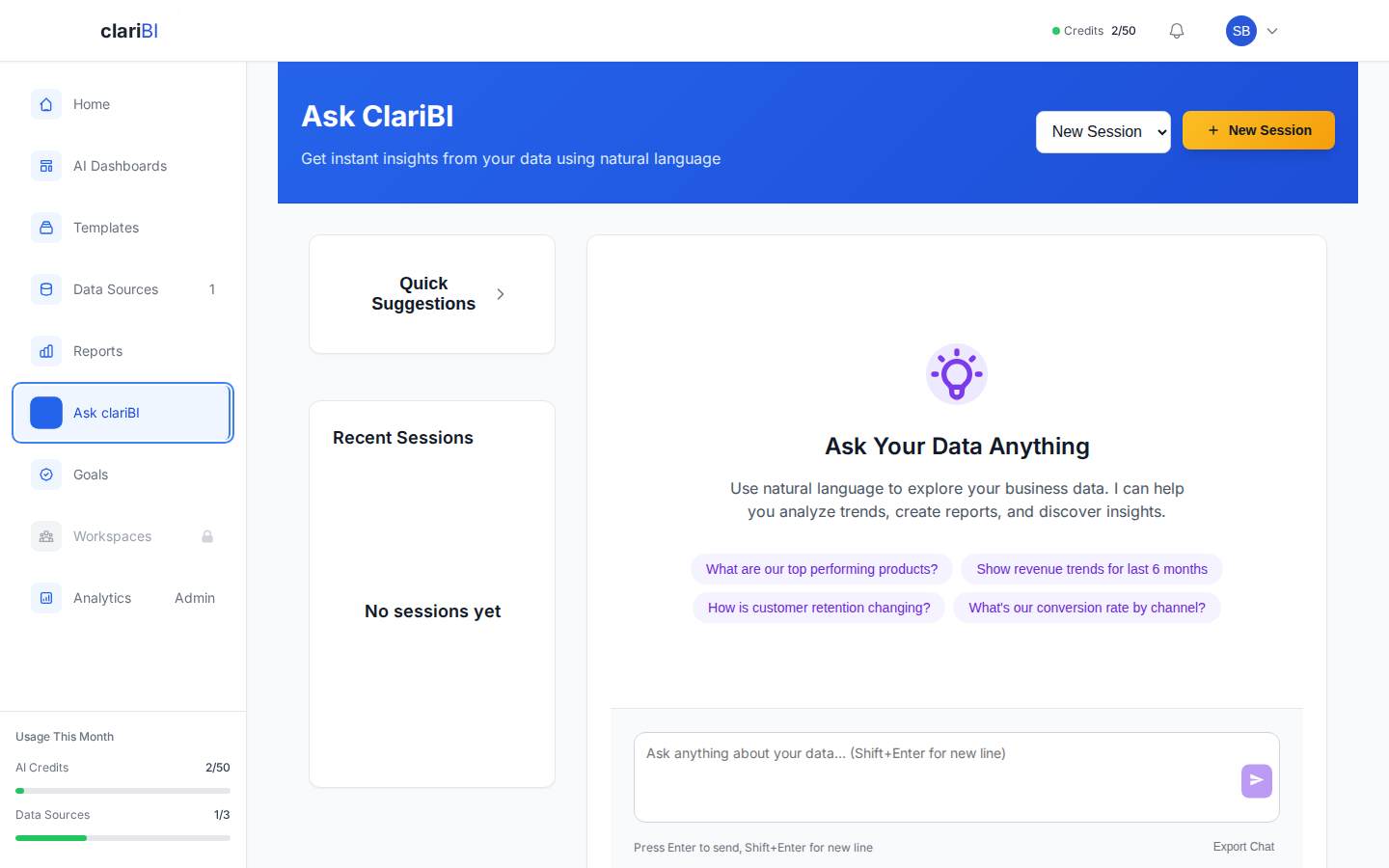
clariBI provides e-commerce analytics capabilities across all growth stages:
- Data Integrations: Connect your e-commerce data through CSV uploads, database connections (PostgreSQL, MySQL), Google Analytics, and REST APIs. Import data from any platform that supports data export.
- E-Commerce Templates: Pre-built dashboards for each growth stage. Start with a conversion funnel template at launch, graduate to CLV and RFM templates as you scale.
- AI-Powered Queries: Ask questions like "Which product categories have the highest repeat purchase rate?" or "Show me CAC by channel for the last 6 months" in natural language.
- Cohort Analysis: Built-in cohort tools for tracking customer retention, revenue, and behavior by acquisition date and channel.
- Scheduled Reports: Set up automated weekly or monthly reports to track conversion rates, CAC, and other key metrics.
Common E-Commerce Analytics Mistakes
- Tracking revenue without margins: Revenue growth with declining margins is not progress. Always pair revenue metrics with profitability metrics.
- Ignoring returns: Returns can eat 20-30% of gross revenue in some categories. Report net revenue after returns, not gross.
- Over-indexing on new customer acquisition: Repeat customers are almost always more profitable than new ones. Balance acquisition and retention analytics.
- Vanity metrics: Social media followers, email list size, and total site visits are interesting but do not directly drive revenue. Focus on metrics that connect to business outcomes.
- Not accounting for seasonality: Comparing January to December in e-commerce is meaningless. Always compare year-over-year or use seasonal baselines.
Conclusion
E-commerce analytics maturity should match business maturity. Track conversion and traffic at launch. Add CAC and repeat rates as you scale. Graduate to CLV, RFM, and unit economics as you optimize. Build predictive and incremental capabilities at enterprise scale. At every stage, focus on the metrics that drive the decisions you need to make right now, and resist the temptation to track everything at once.