For agencies, analytics is not just about understanding performance. It is about proving value. Every month, you need to demonstrate that the client's investment in your services is producing returns. The agencies that do this well retain clients for years. The agencies that do it poorly churn through clients and constantly scramble for new business. This guide covers the frameworks, metrics, and presentation strategies that separate the two.
The Agency Reporting Challenge
Agency reporting is harder than internal reporting for several reasons:
- Multiple clients with different goals: One client cares about leads. Another cares about brand awareness. A third cares about e-commerce revenue. You need flexible reporting that adapts to each.
- Limited data access: You often do not have full access to the client's systems. You see your channels' data but not the full picture.
- Attribution complexity: Clients want to know what your work specifically produced, not what the overall business achieved. Isolating your impact is genuinely difficult.
- Skeptical audiences: Clients are paying you and expect you to make your work look good. They approach your reports with healthy skepticism.
- Time pressure: Producing 20+ client reports per month competes with time spent actually doing the work.
Building a Client Reporting Framework
Step 1: Align on Goals Before Starting Work
Before you produce a single report, get written agreement on:
- Primary KPI: The one metric that defines success for this engagement
- Secondary KPIs: 2-3 supporting metrics that provide context
- Targets: Specific numbers you are aiming for (not "improve" but "increase from 50 to 75")
- Baseline: Where the metric stands before your work begins
- Timeframe: How long before results are expected
This alignment prevents the single biggest source of agency-client friction: the client expected one thing and the agency measured another.
Step 2: Structure Every Report the Same Way
Consistency builds trust. Every monthly report should follow the same structure:
- Executive Summary (1 paragraph): What happened, what it means, what is next. A busy client should be able to read this and nothing else and still understand performance.
- KPI Dashboard: Primary and secondary KPIs with trend lines and target comparisons. Traffic light indicators for instant comprehension.
- Channel Breakdown: Performance by channel or campaign with cost, volume, and efficiency metrics.
- Insights and Learnings: What you discovered this month. What worked, what did not, and what you learned from each.
- Next Steps: Specific actions you will take next month based on this month's data.
Step 3: Choose the Right Metrics by Service Type
For Paid Media Agencies
- Primary: Cost per acquisition (CPA) or return on ad spend (ROAS)
- Supporting: Click-through rate, conversion rate, cost per click
- Volume: Total conversions, total spend, impression share
- Trend: Month-over-month and year-over-year comparisons
For SEO Agencies
- Primary: Organic traffic or organic-sourced revenue
- Supporting: Keyword rankings, domain authority, indexed pages
- Volume: Organic impressions, clicks, new pages ranking
- Trend: Quarter-over-quarter (SEO moves slowly)
For Content Marketing Agencies
- Primary: Leads or pipeline generated from content
- Supporting: Page views, time on page, email signups
- Volume: Content produced, distribution reach, engagement rate
- Trend: Compound content growth over 6-12 months
For Web Development/CRO Agencies
- Primary: Conversion rate improvement
- Supporting: Revenue per visitor, bounce rate, page load time
- Volume: Tests run, winning variations, revenue impact
- Trend: Cumulative revenue impact of optimizations
For Full-Service Agencies
- Primary: Revenue or pipeline attributed to agency activities
- Supporting: Channel-level metrics, campaign-level performance
- Volume: Total marketing-qualified leads, marketing-sourced pipeline
- Trend: Monthly and quarterly, with context for seasonality
Proving ROI: The Math That Matters
Direct ROI Calculation
ROI = (Revenue Attributed to Agency Work - Agency Fees) / Agency Fees x 100

Example:
  Revenue attributed: $180,000
  Agency fees: $15,000/month x 12 = $180,000
  ROI = ($180,000 - $180,000) / $180,000 x 100 = 0%

Wait, that looks bad. But consider:
  Customer lifetime value of those customers: $540,000
  ROI on LTV basis = ($540,000 - $180,000) / $180,000 x 100 = 200%
Always discuss which ROI calculation is appropriate with the client. First-purchase ROI, lifetime ROI, and pipeline ROI tell different stories. Use the one that is honest and relevant.
When Direct ROI Is Hard to Calculate
Not all agency work maps directly to revenue. Brand awareness campaigns, content marketing, and SEO improvements build value over time. For these:
- Show leading indicators: Traffic growth, ranking improvements, email list growth, social engagement
- Benchmark against industry: "Your organic traffic grew 45% while the industry average was 12%"
- Calculate proxy values: "If this organic traffic were paid, it would cost $28,000/month in ad spend"
- Show pipeline contribution: "Content-sourced leads represented 32% of total pipeline this quarter"
Presentation Strategies That Build Trust
1. Lead With the Bad News
Counterintuitive but effective. If something did not work, say so early and explain what you learned and what you are changing. Clients who discover problems themselves trust you less than clients who hear about problems from you first.
2. Show Your Work
Do not just show results. Show the work behind them: campaigns launched, tests run, content produced, optimizations made. This demonstrates the volume and quality of activity, not just outcomes (which can be influenced by factors outside your control).
3. Use Comparisons Generously
Raw numbers are hard to interpret. Always provide context:
- This month vs. last month
- This month vs. same month last year
- Your performance vs. industry benchmarks
- Current vs. pre-engagement baseline
4. Connect Metrics to Business Outcomes
Clients do not care about click-through rates for their own sake. They care because higher CTR means more visitors, which means more customers, which means more revenue. Always trace the path from tactical metrics to business outcomes.
5. Include a Cumulative View
Any single month can look bad due to seasonality or market conditions. A cumulative view shows the trajectory: "Since engagement started 8 months ago, we have generated 1,240 leads, $380K in pipeline, and $127K in closed revenue."
Scaling Reports Across Multiple Clients
Templatize Everything
Build a reporting template for each service type. Each month, update the data and customize the insights. The structure stays the same. This is the only way to produce quality reports for 20+ clients without a dedicated reporting team.
Automate Data Collection
Manually pulling data from Google Ads, Facebook, Google Analytics, and client CRMs for every client every month does not scale. Set up automated data connections that pull metrics into your reporting platform.
Standardize Metrics Across Clients
Use the same metric definitions for all clients in a service category. This lets you benchmark clients against each other (anonymously) and build institutional knowledge about what good performance looks like.
How clariBI Supports Agency Analytics
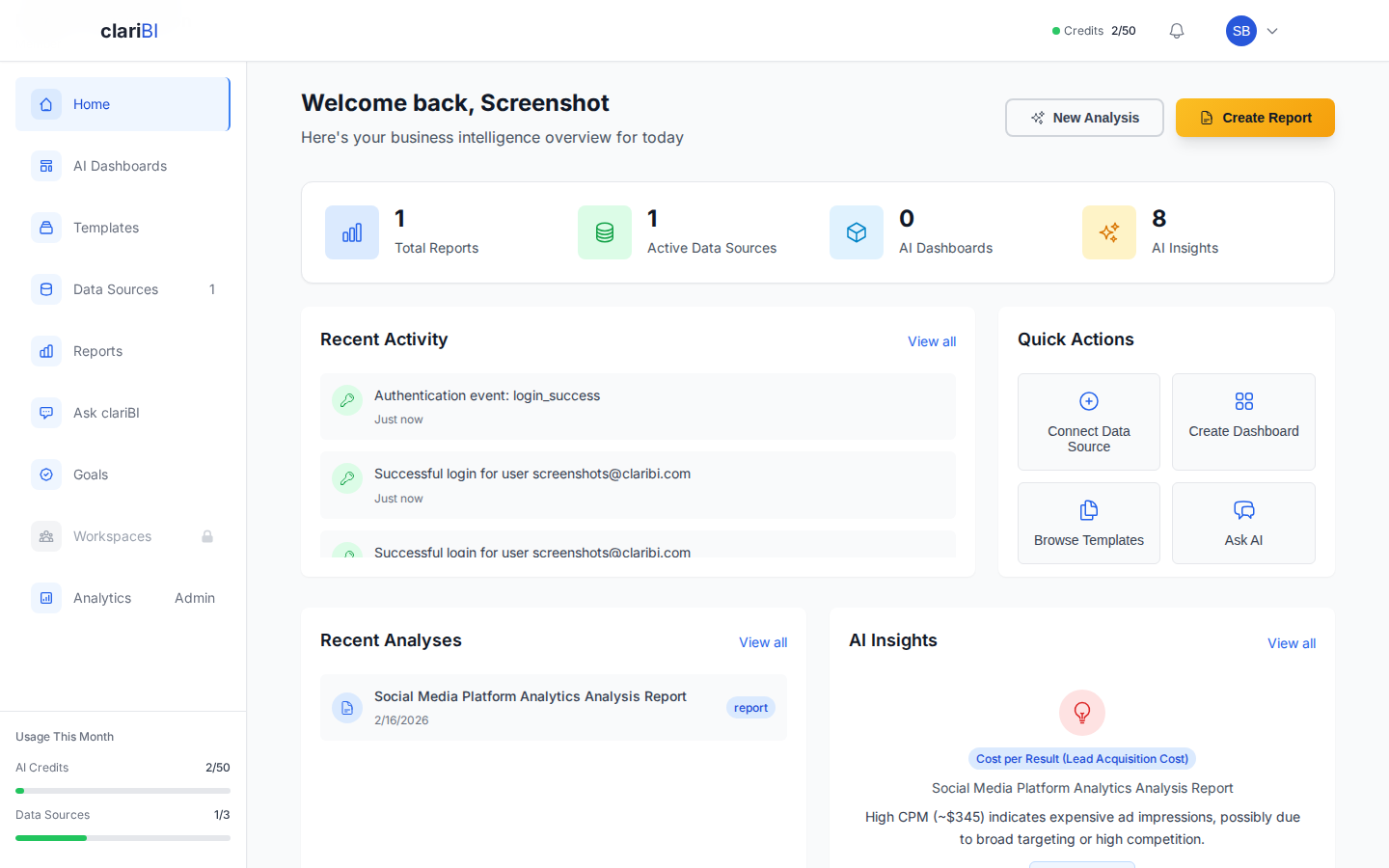
clariBI is built with multi-client workflows in mind:
- Multi-Tenant Architecture: Manage multiple client accounts from a single agency dashboard. Data stays separated; reporting is centralized.
- Client-Specific Data Sources: Connect each client's Google Analytics, ad platforms, CRM, and e-commerce tools independently.
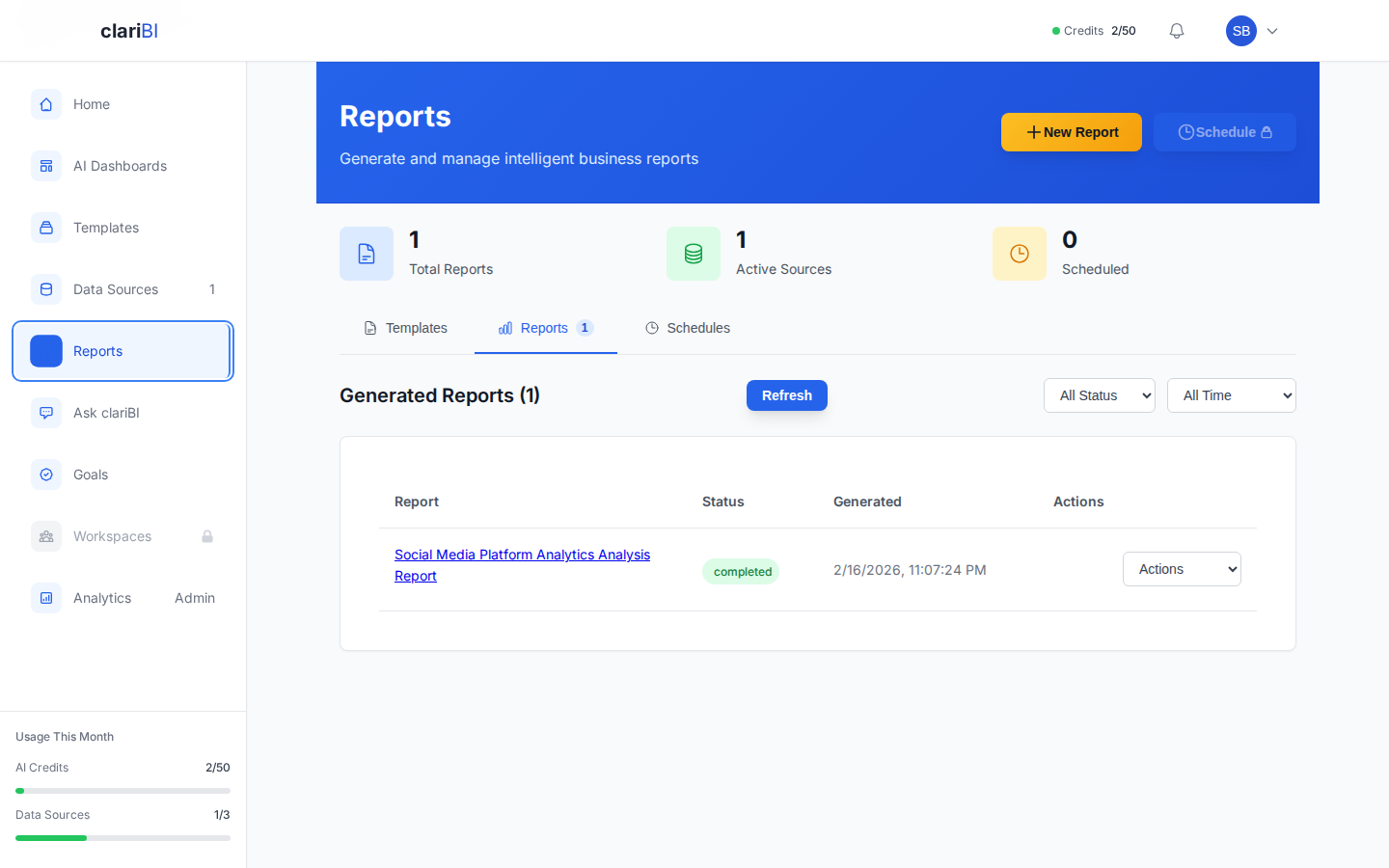
- Report Templates: Build once, apply to all clients. Customize narratives while keeping structure consistent.
- Public Sharing: Generate shareable report links for clients who want self-service access to their dashboards without needing a clariBI account.
- AI-Generated Narratives: Draft report narratives from data automatically, then review and customize before sending to clients. This cuts report production time significantly.
- Workspace Collaboration: Give clients view access to their dashboards for transparency between reporting cycles.
Common Agency Reporting Mistakes
- Burying bad news: Clients who discover problems themselves lose trust. Surface issues proactively with a plan to address them.
- Reporting on activity instead of results: "We published 12 blog posts" is activity. "Blog content generated 89 leads this month" is a result. Lead with results.
- Using jargon: Not all clients speak marketing. Replace CPM, CTR, and ROAS with "cost per thousand impressions," "percentage of people who clicked," and "revenue per dollar spent."
- Inconsistent timing: Deliver reports on the same day every month. Inconsistency signals disorganization.
- No narrative: A dashboard without interpretation is homework for the client. Always include analysis: what the numbers mean and what you recommend.
Conclusion
Agency analytics is ultimately about trust. Clients need to trust that your numbers are accurate, your analysis is honest, and your recommendations are in their interest. Build that trust through consistent reporting, transparent methodology, proactive communication about both wins and challenges, and a clear connection between your work and their business outcomes. The agencies that master this retain clients for years, and client retention is the most important metric in the agency business.