Financial services firms sit on enormous volumes of data - transaction records, credit histories, market feeds, customer interactions, regulatory filings. The firms that win are the ones that turn this data into faster risk decisions, cleaner compliance, and deeper customer understanding. Here is how analytics applies across the three pillars of financial services: risk, compliance, and customer intelligence.
The Analytics Imperative in Financial Services
Financial services operate under unique pressures that make analytics not optional but essential:
- Regulatory scrutiny: Regulators expect institutions to demonstrate data-driven risk management. "We thought it was fine" is not an acceptable answer during an examination.
- Thin margins on scale: When you process millions of transactions, a 0.1% improvement in loss rates translates to significant dollar savings.
- Customer expectations: Fintech competitors offer personalized, instant experiences. Traditional institutions need analytics to compete.
- Fraud evolution: Criminals adapt constantly. Static rules catch yesterday's fraud. Analytics catches tomorrow's.
Pillar 1: Risk Scoring and Management
Risk is the core business of financial services. Every loan, every policy, every trade involves assessing and pricing risk. Analytics makes that assessment faster and more accurate.
Credit Risk Scoring
Traditional credit scoring relies on a handful of variables: payment history, outstanding debt, length of credit history, credit mix, and recent inquiries. Modern analytics expands this significantly.
Key metrics for a credit risk dashboard:
- Portfolio delinquency rates: Track 30-day, 60-day, and 90-day delinquency rates by product, vintage, and segment. A rising 30-day rate is an early warning of future charge-offs.
- Migration analysis: What percentage of accounts move from current to 30-day late, from 30 to 60, and so on? Migration rates predict future losses more reliably than snapshot delinquency.
- Concentration risk: How exposed is the portfolio to specific industries, geographies, or borrower types? Concentration makes you vulnerable to sector-specific downturns.
- Loss given default (LGD): When a borrower defaults, how much do you actually lose after recovery efforts? LGD varies significantly by collateral type and economic conditions.
- Probability of default (PD) model performance: How well does your scoring model separate borrowers who default from those who don't? Track the Gini coefficient or KS statistic over time to detect model degradation.
Market Risk
For firms with trading operations or investment portfolios:
- Value at Risk (VaR): The maximum expected loss over a given time period at a given confidence level. Track actual losses against VaR predictions to validate your model.
- Stress test results: How does the portfolio perform under adverse scenarios? Track how stress losses change as portfolio composition shifts.
- Exposure by asset class and counterparty: Where is the money, and who owes you?
Operational Risk
Operational risk is the hardest to quantify but can be the most damaging:
- Incident frequency and severity: Track operational loss events by category (fraud, processing errors, system failures, compliance breaches).
- Near-miss events: Events that could have caused loss but were caught. A rising near-miss rate may indicate deteriorating controls.
- Key Risk Indicators (KRIs): Leading indicators like employee turnover in critical functions, system downtime frequency, or exception processing volumes.
Building a Risk Dashboard
An effective risk dashboard has layers:
- Executive summary: Portfolio-level risk metrics with trend arrows and threshold indicators. Red/yellow/green status for each risk category.
- Segment drill-down: Break risk metrics by product line, geography, customer segment, and vintage. This is where you find emerging problems.
- Model monitoring: Track model performance metrics over time. Models degrade as economic conditions change and population characteristics shift.
- Limit monitoring: Track actual exposures against approved limits. Alert when utilization approaches thresholds.
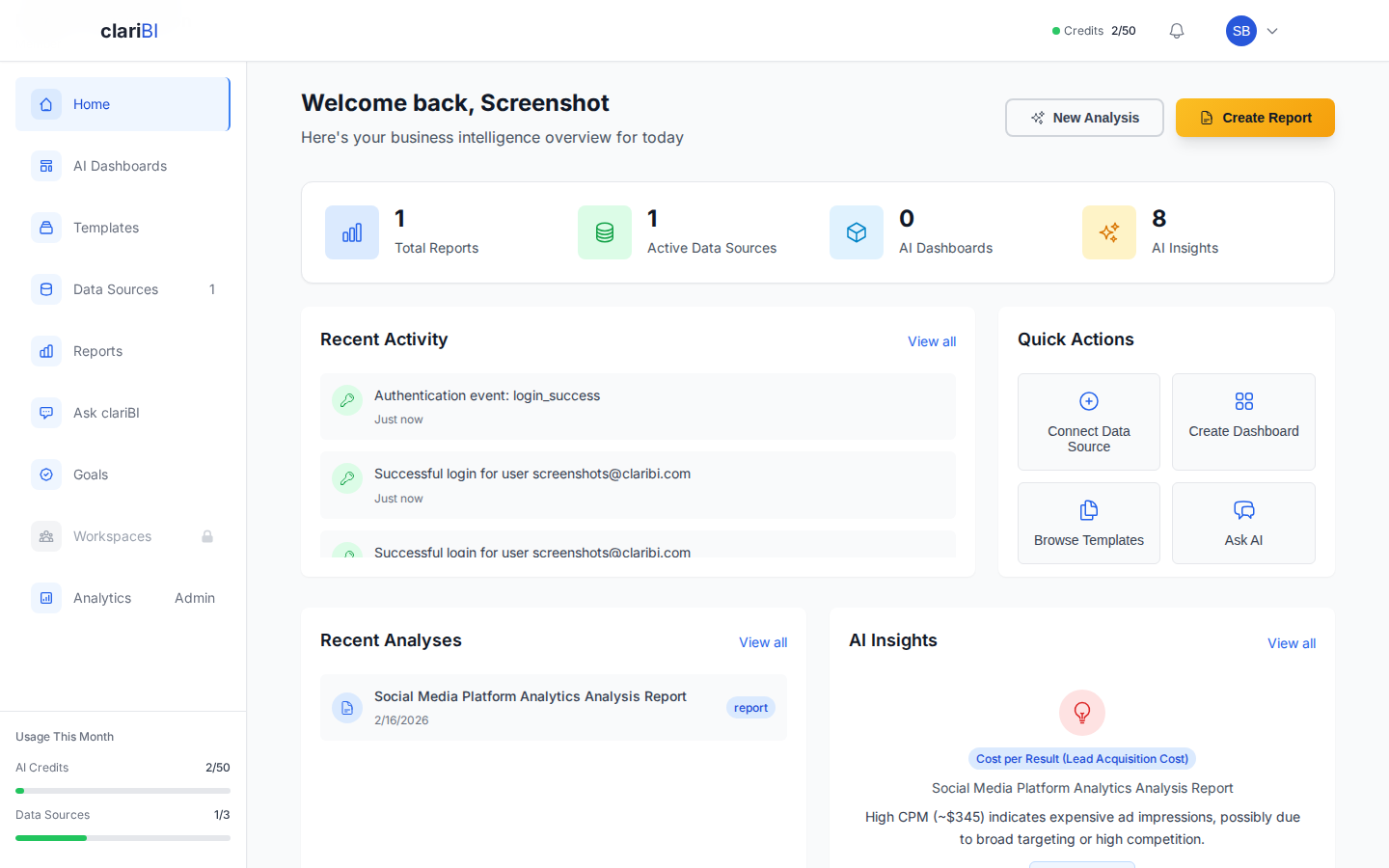
With clariBI, you can connect to your core banking system or data warehouse and build these layered dashboards. The natural language interface is particularly useful for risk analysts who need to investigate anomalies quickly - asking "Show me the top 10 segments by 30-day delinquency increase this quarter" is faster than building a custom report from scratch.
Pillar 2: Compliance and Regulatory Reporting
Compliance is not glamorous, but it is non-negotiable. Regulatory fines in financial services have totaled hundreds of billions of dollars over the past decade. Analytics helps in two ways: automating the reporting itself, and monitoring for compliance issues before regulators find them.
Anti-Money Laundering (AML) Analytics
AML compliance generates enormous volumes of alerts, most of which are false positives. Analytics helps by:
- Alert scoring: Prioritizing alerts by risk level so investigators focus on the most suspicious activity first.
- Network analysis: Identifying connected accounts and transaction patterns that suggest coordinated laundering activity.
- Suspicious Activity Report (SAR) filing metrics: Track SAR volumes, filing timeliness, and case resolution rates. Regulators pay attention to these operational metrics.
- False positive rate: What percentage of alerts are closed with no finding? A rate above 95% suggests your rules need tuning. A rate that drops suddenly may indicate the rules changed unintentionally.
Regulatory Reporting Dashboards
Key compliance metrics to track:
- Report submission timeliness: Are regulatory reports filed on time? Track by report type and deadline.
- Data quality scores: What is the error rate in submitted reports? Many regulators now score data quality and follow up on institutions with high error rates.
- Examination findings: Track open findings, remediation status, and aging. An old open finding is worse than a new one.
- Training completion: Track compliance training completion rates by department and role. Gaps in training are gaps in defense.
- Policy exception tracking: How many exceptions to standard policies are active? Are they properly approved and time-limited?
Know Your Customer (KYC) Metrics
KYC processes are often a bottleneck in customer onboarding:
- Onboarding cycle time: How long from application to account opening? Break down by customer type (individual, business, high-risk).
- Document collection rate: What percentage of required documents are collected on first request versus requiring follow-up?
- Enhanced due diligence (EDD) volume: How many customers require EDD, and what is the average processing time?
- Periodic review completion: Are existing customer reviews completed on schedule?
Pillar 3: Customer Intelligence
In an industry where products are largely commoditized, understanding customers better than competitors is a durable advantage.
Customer Lifetime Value (CLV)
Financial services CLV calculation considers:
- Product revenue: Interest income, fee income, and commission income by product
- Cost to serve: Branch visits, call center contacts, digital interactions, servicing costs
- Credit losses: Expected losses for lending products
- Retention probability: How likely is the customer to remain over the next 1, 3, and 5 years?
- Cross-sell potential: What additional products is the customer likely to adopt?
Segmenting customers by CLV allows better allocation of service resources, marketing spend, and retention efforts.
Product Penetration and Cross-Sell
- Products per customer: Average number of products held. Higher penetration correlates strongly with retention.
- Next-best-product analysis: Based on customer profile and behavior, which product is most likely to be adopted next?
- Wallet share estimation: What share of the customer's total financial activity do you capture?
Attrition Analysis
- Churn rate by segment: Which customer segments have the highest attrition? Is it voluntary (customer leaves) or involuntary (charged off)?
- Early warning indicators: Declining transaction frequency, reduced balance, decreased digital login frequency - these often precede account closure by 60-90 days.
- Win-back rates: Of customers who left, how many were successfully won back? What offers worked?
Channel Analytics
Understanding how customers interact across channels:
- Channel preference by segment: Which customers prefer mobile, online, branch, or phone?
- Digital adoption rate: What percentage of transactions occur through digital channels? Track the trend - most institutions are trying to shift activity to lower-cost digital channels.
- Channel migration: Are customers moving from branch to digital, or vice versa? Forced migration (branch closures) often backfires without analytics to guide the transition.
Implementation Considerations
Data Integration Challenges
Financial institutions typically have data scattered across dozens of systems: core banking, card processing, loan origination, CRM, trading platforms, and more. Many of these are legacy systems with proprietary data formats.
Practical advice:
- Start with one data source that answers a specific business question, rather than trying to integrate everything at once
- Invest in a consistent customer identifier across systems - without it, customer-level analytics is impossible
- Accept that some data will be imperfect. Perfect data is the enemy of useful analytics.
Security and Access Control
Financial data requires strict access controls. Your analytics platform must support:
- Role-based access so that compliance sees compliance data and lending sees lending data
- Audit trails showing who accessed what data and when
- Data masking for sensitive fields like SSN and account numbers in non-production environments
clariBI's RBAC system supports this, with configurable roles and permissions that can restrict data access by department and sensitivity level. The audit logging feature provides the trail regulators expect.
Model Governance
If you use models for risk scoring or customer segmentation, regulators expect governance:
- Model inventory - what models exist, who owns them, when were they last validated
- Performance monitoring - are models still performing within acceptable bounds
- Change management - how are model changes tested, approved, and implemented
Getting Started
Financial services analytics projects fail most often from over-ambition, not under-ambition. Start with one pillar, one use case, one dashboard that answers a question someone is currently answering manually with spreadsheets. Prove the value, then expand.
For most institutions, the highest-impact starting point is whichever area currently consumes the most analyst time in manual reporting. If your team spends three days each month assembling the board risk report, start there. If compliance alert investigation is the bottleneck, start there. Follow the pain.