Healthcare organizations generate more data per patient encounter than most industries generate per customer in a year. Electronic health records, claims data, lab results, scheduling systems, supply chain logs, and patient satisfaction surveys all produce streams of information. But having data and using data are two different things. This guide covers the three pillars of healthcare analytics—patient outcomes, operational efficiency, and regulatory compliance—and shows how to build reporting that actually changes how care is delivered and how organizations are managed.
Why Healthcare Analytics Is Different
Healthcare analytics shares some DNA with analytics in other industries, but several factors set it apart:
- Regulatory requirements are non-negotiable. HIPAA, HITECH, CMS reporting requirements, and state-level mandates mean that data handling, access controls, and audit trails are not optional features. They are legal requirements with significant penalties for non-compliance.
- Data is fragmented across systems. A single patient encounter might generate data in the EHR, the billing system, the lab information system, the pharmacy system, and the scheduling platform. Getting a complete picture requires connecting these sources.
- Outcomes take time to measure. Unlike e-commerce where you know within days whether a campaign worked, clinical outcomes can take weeks, months, or years to materialize. Readmission rates require 30-day tracking. Chronic disease management outcomes unfold over years.
- Stakeholders have different needs. Clinicians want patient-level detail. Administrators want department-level efficiency metrics. Compliance officers want audit-ready reports. Finance wants revenue cycle data. One dashboard does not serve all of them.
- Data quality issues are common. Manual data entry by clinicians under time pressure leads to inconsistencies. Diagnosis codes can be wrong. Timestamps can be inaccurate. Any analytics initiative has to account for data quality problems from the start.
Pillar 1: Patient Outcomes Analytics
Patient outcomes are the most important category of healthcare metrics. Everything else—efficiency, revenue, compliance—ultimately serves the goal of better patient care. Here are the metrics that matter most and how to track them effectively.
Mortality and Morbidity Rates
Risk-adjusted mortality rates are the most scrutinized outcome metrics in healthcare. Raw mortality numbers are misleading because patient populations vary dramatically between facilities. A hospital that treats the sickest patients will always have higher raw mortality. Risk adjustment normalizes for patient acuity so you can compare apples to apples.
Track mortality rates by:
- Condition: Separate rates for heart failure, pneumonia, stroke, surgical procedures, and other major categories
- Time period: In-hospital mortality, 30-day mortality, and 90-day mortality each tell different stories
- Department: ICU, surgical, medical, and emergency department mortality rates highlight department-specific issues
- Trend: A single quarter's numbers are noise. Twelve months of trending data shows whether interventions are working
Readmission Rates
Hospital readmissions within 30 days are both a quality indicator and a financial one. CMS penalizes hospitals with excessive readmissions for certain conditions through the Hospital Readmissions Reduction Program (HRRP). The financial penalty alone makes this a metric that leadership pays attention to.
Effective readmission analytics goes beyond tracking the rate. It identifies patterns:
- Which diagnoses have the highest readmission rates?
- Are readmissions clustered in certain time windows (days 3-7 vs. days 20-30)?
- Do patients discharged on certain days of the week have higher readmission rates?
- Are specific discharge dispositions (home vs. skilled nursing facility) associated with different readmission rates?
- Do patients who received follow-up calls or appointments within 48 hours of discharge have lower readmission rates?
Patient Safety Indicators
AHRQ Patient Safety Indicators (PSIs) track adverse events that might be preventable. Key ones include:
- PSI 03: Pressure ulcer rate
- PSI 06: Iatrogenic pneumothorax rate
- PSI 08: In-hospital fall with hip fracture rate
- PSI 12: Perioperative pulmonary embolism or deep vein thrombosis rate
- PSI 15: Unrecognized abdominopelvic accidental puncture or laceration rate
These indicators should be tracked monthly with rolling 12-month trends. Set up alerts when any indicator crosses a threshold, so quality teams can investigate before the next quarterly review cycle.
Patient Experience Scores
HCAHPS (Hospital Consumer Assessment of Healthcare Providers and Systems) survey scores quantify patient experience across dimensions like communication with nurses, communication with doctors, responsiveness of hospital staff, pain management, discharge information, and overall hospital rating.
HCAHPS scores affect both CMS reimbursement and public reputation. Track them alongside operational metrics to find correlations. Hospitals that consistently score well on nurse communication, for example, often have lower nurse-to-patient ratios and lower nurse turnover. Understanding these connections turns patient experience from a soft metric into an actionable one.
Clinical Quality Measures
Clinical quality measures (CQMs) track adherence to evidence-based care processes. Examples include:
- Percentage of heart failure patients prescribed ACE inhibitors or ARBs at discharge
- Percentage of stroke patients receiving antithrombotic therapy by end of hospital day two
- Percentage of surgical patients who received appropriate prophylactic antibiotics within one hour before incision
- Percentage of diabetic patients with HbA1c testing in the past year
These measures connect process (what care was delivered) to outcomes (how patients fared). When a quality measure drops, investigate whether the care process changed or whether the patient population shifted.
Pillar 2: Operational Efficiency Analytics
Healthcare operations are complex. Hospitals operate 24/7 with variable patient volumes, staffing constraints, equipment limitations, and supply chain dependencies. Efficiency analytics identifies where resources are wasted, where bottlenecks form, and where small improvements yield significant savings.
Bed Utilization and Patient Flow
Bed management is one of the highest-impact operational challenges in healthcare. Key metrics include:
- Occupancy rate: What percentage of beds are occupied at any given time? Rates above 85% often correlate with increased wait times, boarding in the ED, and higher stress on staff.
- Average length of stay (ALOS): Track by diagnosis group (DRG) and compare against national benchmarks. A higher-than-expected ALOS for a specific DRG suggests an opportunity for care pathway improvement.
- Discharge timing: Track when discharges actually happen versus when they are ordered. A common pattern is discharge orders placed by 10 AM but patients not leaving until 3 PM, blocking beds for incoming patients during the busiest admission hours.
- ED boarding time: How long do admitted patients wait in the emergency department for an inpatient bed? This is a safety issue and a patient experience issue.
- Surgical case turnaround: Time between one surgical case ending and the next beginning. Even 10-minute improvements per case add up to additional cases per OR per week.
Staffing Efficiency
Labor is the largest expense in healthcare, typically 50-60% of total operating costs. Staffing analytics should track:
- Nurse-to-patient ratios: By unit, by shift, and compared against patient acuity levels
- Overtime hours: Excessive overtime signals understaffing or scheduling problems, and it costs 1.5x the regular rate
- Agency and travel staff usage: Temporary staff costs 2-3x permanent staff. Track the percentage of shifts filled by agency workers as a key efficiency indicator
- Turnover rate: Replacing a nurse costs $40,000-$60,000. Tracking turnover by department identifies problem areas before they become crises
- Productivity metrics: Relative Value Units (RVUs) per provider, patients seen per shift, procedures completed per block of OR time
Supply Chain and Cost per Case
Supply costs are the second largest expense after labor. Track:
- Cost per case by DRG: Compare against reimbursement to identify procedures that are profitable versus those that lose money
- Implant and device costs: High-cost items like orthopedic implants, cardiac devices, and surgical robots need item-level tracking and physician-level usage patterns
- Waste metrics: Expired supplies, opened-but-unused surgical supplies, and food waste in patient nutrition services
- Pharmacy costs: Drug costs per patient day, formulary compliance rates, and generic substitution rates
Revenue Cycle Metrics
Revenue cycle analytics bridges clinical operations and financial performance:
- Days in accounts receivable (AR): How quickly are claims being paid? Industry benchmark is under 40 days. Over 50 days signals collection problems.
- Clean claim rate: What percentage of claims are accepted on first submission? Each rejected claim costs $25-$30 to rework. A clean claim rate below 90% indicates coding or documentation issues.
- Denial rate by payer: Which insurance companies deny the most claims, and for what reasons? This data drives both appeals strategy and contract negotiations.
- Case mix index (CMI): The average relative weight of all DRGs. A declining CMI with stable volume might indicate undercoding. A rising CMI might indicate more complex patients or upcoding that needs review.
- Charge capture rate: Are all services being billed? Missed charges for supplies, procedures, and professional fees directly reduce revenue.
Pillar 3: Compliance and Regulatory Analytics
Healthcare is one of the most regulated industries. Compliance analytics is not a nice-to-have. It is a requirement for continued operation, accreditation, and reimbursement. Here are the key areas to monitor.
HIPAA Compliance Monitoring
HIPAA violations carry fines ranging from $100 to $50,000 per violation (and up to $1.5 million per year for repeated violations of the same provision). Monitor:
- Access log audits: Who accessed which patient records, when, and from where? Flag unusual patterns: accessing records outside working hours, accessing records of patients not in the staff member's care, and bulk record access.
- Minimum necessary compliance: Are users accessing only the information they need for their role? Role-based access controls should limit what each user can see, and audit logs should confirm the controls are working.
- Breach incident tracking: Number of reported incidents, time to detection, time to notification, and root cause categories. The goal is zero breaches, but the realistic goal is fast detection and proper response.
- Training completion: HIPAA training compliance rates by department and role. Non-completion is both a compliance risk and a leading indicator of potential violations.
CMS Quality Reporting
CMS requires reporting on dozens of quality measures that affect reimbursement through programs like:
- Hospital Value-Based Purchasing (VBP): Up to 2% of Medicare reimbursement at risk based on quality scores
- Hospital Readmissions Reduction Program (HRRP): Up to 3% penalty for excess readmissions
- Hospital-Acquired Condition Reduction Program (HACRP): 1% payment reduction for hospitals in the bottom quartile
- Merit-based Incentive Payment System (MIPS): Up to 9% adjustment (positive or negative) for eligible clinicians
Build dashboards that track these measures in real time rather than discovering problems after the reporting period closes. Monthly compliance reviews with drill-down capability let quality teams intervene early.
Accreditation Readiness
Joint Commission and other accrediting bodies evaluate hundreds of standards during surveys. Analytics can support continuous readiness by monitoring:
- Core measure compliance rates: By measure set, by unit, trending over time
- Policy review status: Which policies are due for review or overdue?
- Equipment maintenance logs: Are biomedical devices calibrated and maintained on schedule?
- Environment of care rounds: Findings tracking, remediation status, and repeat findings by category
Infection Control and Prevention
Healthcare-associated infections (HAIs) are tracked by the CDC through the National Healthcare Safety Network (NHSN). Key metrics:
- Central line-associated bloodstream infections (CLABSI): Tracked as Standardized Infection Ratio (SIR) against national baseline
- Catheter-associated urinary tract infections (CAUTI): Rates per 1,000 catheter days
- Surgical site infections (SSI): By procedure type and surgeon
- Clostridioides difficile (C. diff): Hospital-onset cases per 10,000 patient days
- Hand hygiene compliance: Observation rates by department and role
Display these on infection control dashboards with statistical process control charts. An SPC chart shows when variation is random versus when it signals a real change that needs investigation.
Building a Healthcare Analytics Program
Technology is only one part of the equation. A successful healthcare analytics program requires governance, culture, and process alongside the right tools.
Start With Three High-Impact Dashboards
Do not try to build analytics for everything at once. Pick three use cases where data-driven decisions can produce measurable improvement:
- ED throughput dashboard: Door-to-provider time, boarding hours, left-without-being-seen rate. These metrics are visible, actionable, and affect both patient experience and revenue.
- Readmission risk dashboard: Flag patients at high risk of readmission at the time of discharge. Even simple risk models based on diagnosis, age, and prior admissions can reduce readmissions when paired with follow-up protocols.
- Financial performance dashboard: Revenue per adjusted discharge, cost per case by DRG, AR days, and denial rates. This gives leadership a daily pulse on financial health.
Address Data Quality First
The most common failure mode for healthcare analytics is building dashboards on top of unreliable data. Before investing in visualization, invest in data quality:
- Profile your data: What percentage of required fields are populated? What are the most common data entry errors? Where are the inconsistencies between systems?
- Establish data definitions: Does "length of stay" include the admission day, the discharge day, both, or neither? Does "readmission" count planned readmissions or only unplanned ones? Document these definitions and make them accessible.
- Automate validation: Build checks that flag anomalies: impossible values, missing required fields, records that do not match between systems. Catch problems before they reach the dashboard.
Governance and Access
Healthcare data governance requires more rigor than most industries:
- Role-based access control: Not everyone should see all data. Clinicians need patient-level detail. Administrators need aggregate data. Compliance officers need audit logs. Build access policies that match.
- De-identification for analytics: When possible, use de-identified or aggregated data for analytics. This reduces HIPAA exposure while still enabling insights.
- Audit everything: Every report access, every data export, every query should be logged. This is not just a compliance requirement. It also helps you understand how data is being used and by whom.
How clariBI Supports Healthcare Analytics
clariBI provides several capabilities specifically relevant to healthcare organizations:
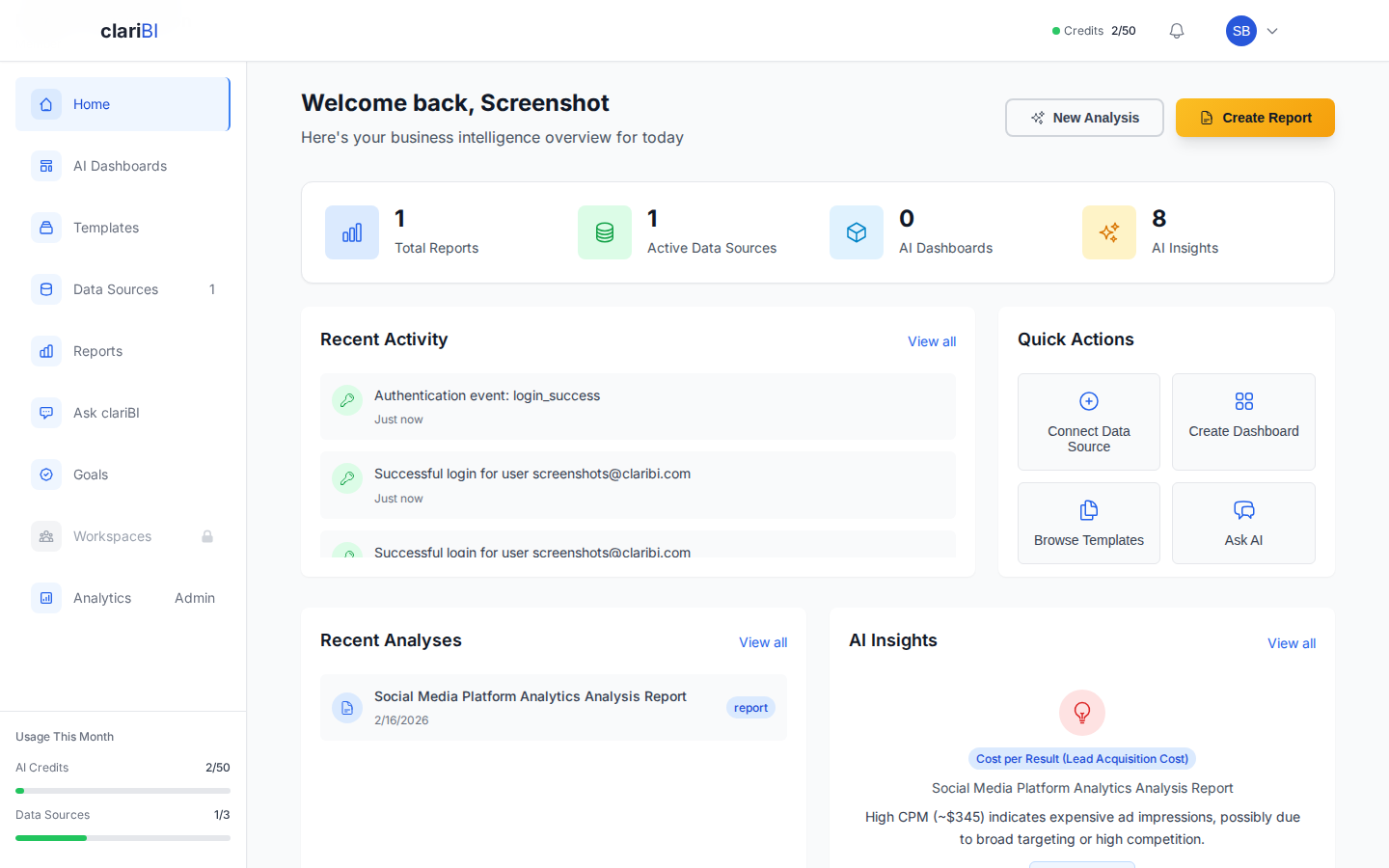
- Multi-source data connections: Connect your EHR database, billing system, scheduling platform, and other clinical systems as separate data sources, then build dashboards that pull from all of them. See the data sources documentation for connection setup guides.
- Role-based access control: clariBI's five-tier RBAC system (Owner, Administrator, Analyst, Member, Viewer) maps well to healthcare organizational structures. Assign clinicians as Analysts with access to clinical data, give administrators broader access, and keep board members as Viewers with access to aggregate dashboards only. See the RBAC guide for configuration details.
- Audit logging: Every action in clariBI is logged with user identity, timestamp, and action details. Export audit logs for compliance reviews or integrate them with your organization's security information and event management (SIEM) system. Learn more in the audit logging documentation.
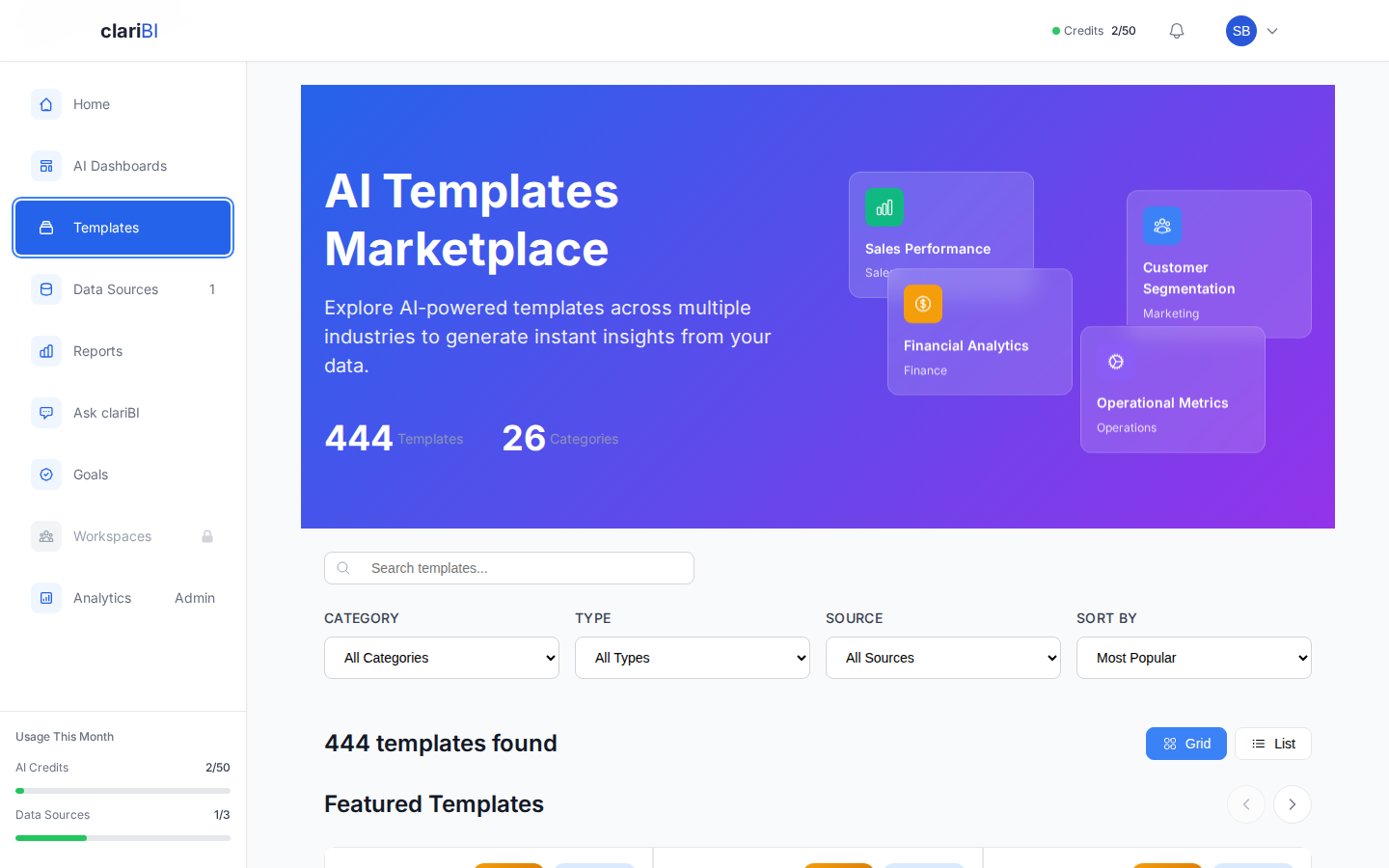
- Dashboard templates: The template marketplace includes healthcare-specific templates for patient outcomes, ED throughput, financial performance, and infection control. These provide a starting point that you can customize for your organization's specific metrics and data structures.
- Scheduled reports: Automate daily, weekly, and monthly report generation and distribution. Quality teams can receive daily infection control updates, finance can get weekly revenue cycle summaries, and leadership can receive monthly executive dashboards without manual effort. Visit the scheduled reports guide for setup instructions.
- AI-assisted analysis: Use conversational analytics to explore clinical and operational data with natural language questions. Ask "What was our readmission rate for heart failure patients last quarter?" and get an answer without writing a query.
Common Mistakes in Healthcare Analytics
- Reporting without context: A 3% readmission rate means nothing without knowing the patient population, the time period, and the national benchmark. Every metric needs context.
- Ignoring data latency: Claims data can lag by 60-90 days. If your dashboard shows "current" data that is actually three months old, decisions based on it may be wrong. Label data freshness clearly.
- Building for regulators instead of clinicians: Compliance reporting is mandatory, but it should not be the only use of analytics. The biggest value comes from dashboards that help clinicians and managers make better day-to-day decisions.
- Skipping risk adjustment: Comparing raw outcome rates between departments or facilities without adjusting for patient acuity is misleading and can demotivate high-performing teams that happen to treat sicker patients.
- Over-engineering the first iteration: Start with simple metrics on reliable data. You can add complexity later. A simple dashboard that people actually use is worth more than a sophisticated one that no one trusts because the data looks wrong.
Conclusion
Healthcare analytics sits at the intersection of patient care, operational management, and regulatory compliance. The organizations that do it well see measurable improvements in all three areas: better outcomes for patients, more efficient use of resources, and smoother compliance processes. The key is starting with high-impact use cases, investing in data quality before building dashboards, governing data access carefully, and building a culture where data-informed decisions are the norm rather than the exception. The data is already there in your systems. The question is whether you are organized to use it.